 Posted by
 Introduction
As a Site Reliability & Platform Engineer, I’ve seen how a CI CD pipeline transforms software delivery. It automates integration, testing, and deployment, ensuring reliability and speed — essential for modern engineering teams and interview preparation.
Early in my career, deployments meant late nights, manual testing, and stressful rollouts. Over time, I realized CI/CD isn’t just a technical process — it’s a mindset that enterprises, especially banks and large organizations, expect engineers to master.
What is CI/CD?
- Continuous Integration (CI): Developers merge code frequently into a shared repository. Automated builds and tests run to catch issues early.
- Continuous Deployment (CD): Once code passes tests, it’s automatically deployed to production or staging environments.
💡 My reflection: In one of my projects, introducing automated build and test stages reduced deployment errors by nearly 70%. That’s the kind of impact recruiters want to hear about in interviews.
👉 Further Reading: Continuous Integration and Delivery overview on AWS (aws.amazon.com in Bing)
Why CI/CD Matters
- Speed: Faster delivery cycles mean features reach users quickly.
- Reliability: Automated tests ensure stability before code hits production.
- Consistency: Every deployment follows the same pipeline, reducing human error.
- Scalability: Pipelines can handle multiple microservices across environments.
💡 My thought: For SRE roles, CI/CD isn’t optional — it’s proof you can balance speed with reliability.
Reference: Jenkins official documentation on CI/CD pipelines (jenkins.io in Bing)
Related Post: AWS Glue Crawler Explained what-is-aws-glue-crawler?
Key Components of a CI/CD Pipeline
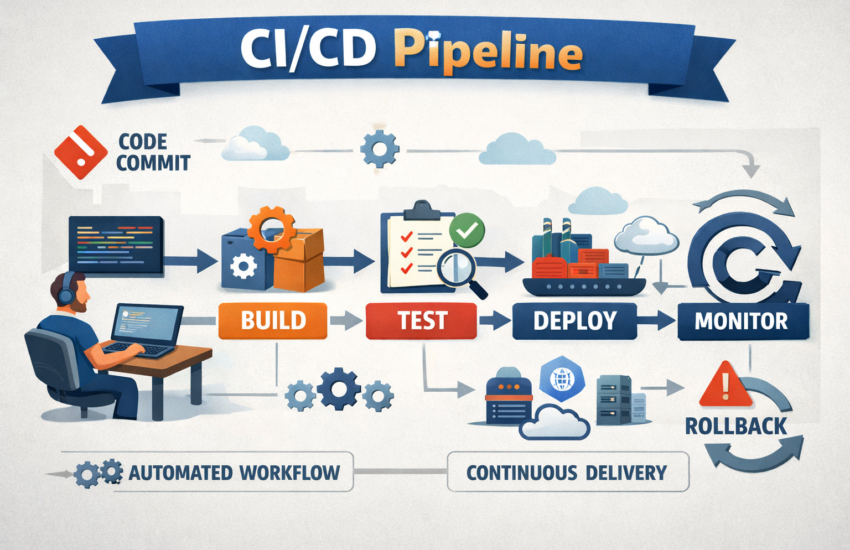
- Source Control Integration – Code pushed to GitHub/GitLab triggers pipelines.
- Build Stage – Compiles code, packages artifacts.
- Test Stage – Runs unit/integration tests automatically.
- Deploy Stage – Pushes builds to environments (VMs, containers, Kubernetes).
- Rollback Mechanism – Ensures quick recovery if a deployment fails.
- Monitoring Hooks – Alerts teams about failures or anomalies.
💡 My practice: I always include a validation stage and artifact storage. This supports rollback — a detail that impresses interviewers.
Security and Secrets Management
CI/CD pipelines often need credentials (cloud keys, Docker registry passwords). Best practice is to store them securely in vaults or pipeline secrets.
💡 My reflection: I highlight this in my CV because secure handling of secrets shows maturity in reliability engineering.
Learn more: GitHub Actions secrets management guide (docs.github.com in Bing)
Observability in CI/CD
Monitoring isn’t just for production systems. Pipelines themselves need observability:
- Notifications via Slack/Teams when builds fail.
- Dashboards showing pipeline health.
- Logs for debugging failed stages.
💡 My thought: As an SRE, I treat pipelines as part of the system’s reliability surface.
Explore: Grafana documentation on pipeline monitoring
Interview Relevance
CI/CD is a recurring theme in interviews. Some common questions:
- “Explain the stages of a CI/CD pipeline.”
- “How would you design rollback in CI/CD?”
- “What’s the difference between CI and CD?”
💡 My reflection: I’ve used my own pipeline designs as examples in interviews, which made my answers stand out as practical, not just theoretical.
Conclusion
CI/CD is more than automation — it’s a philosophy of delivering software reliably, securely, and at speed. For me, mastering CI/CD has been a career milestone, bridging my Python developer foundation with my current SRE role.
If you’re preparing for interviews or building credibility in cloud/SRE roles, understanding CI/CD theory and being able to explain it clearly is just as important as hands‑on practice.
For a broader perspective, check out Google Cloud’s CI/CD best practices (cloud.google.com in Bing)